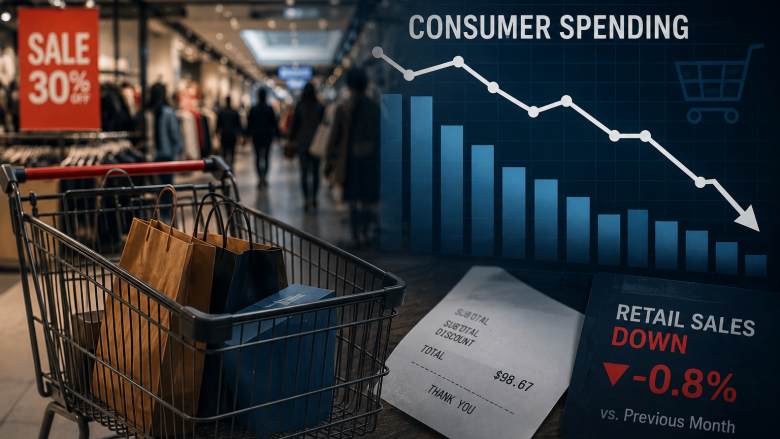
American consumers have been the engine of the US economy for decades, and for the past several years, their resilience in the face of rising prices and higher interest rates has confounded economists who predicted a deeper slowdown. But the data from early 2026 suggests that the long-anticipated consumer fatigue is finally arriving — not as a cliff edge, but as a gradual erosion that is showing up in retail sales figures, credit card delinquency rates, and the earnings reports of major consumer companies.
The Retail Sales Picture
The Commerce Department’s April 2026 retail sales report showed a 0.3% month-over-month decline after adjusting for seasonal factors, following a downwardly revised 0.2% drop in March. That marks two consecutive months of contraction — the first back-to-back decline since late 2023. More telling than the headline number is the composition: sales at department stores fell 1.1%, furniture and home furnishing stores shed 0.8%, and electronics retailers saw a 0.6% pullback.
The categories that held up were largely necessity-driven. Grocery store sales rose 0.4%, pharmacy and drugstore sales edged up 0.2%, and gas station receipts increased as oil prices climbed. This pattern — consumers pulling back on discretionary items while maintaining spending on essentials — is a textbook sign of a household sector under pressure.
The National Retail Federation revised its full-year 2026 sales growth forecast from 4.5% to 2.8% in its May update, citing “persistent affordability challenges and the cumulative weight of two years of elevated interest rates on household balance sheets.”
The Credit Story
Perhaps the most revealing indicator of consumer stress is what is happening in credit markets. The Federal Reserve’s consumer credit data shows that revolving credit — primarily credit cards — grew by just $2.1 billion in March 2026, down sharply from an average monthly increase of $7.8 billion in 2024. This slowdown in credit card borrowing does not necessarily reflect financial prudence; it more likely reflects borrowing limits being reached.
The New York Federal Reserve’s Center for Microeconomic Data reported in its Q1 2026 Household Debt and Credit Report that credit card delinquencies — defined as payments more than 30 days late — rose to 9.1% of outstanding balances, the highest level since 2011. Auto loan delinquencies climbed to 8.4%, up from 7.6% a year earlier. These figures suggest that a meaningful segment of the consumer population is running out of financial runway.
The average credit card interest rate, as tracked by the Fed, stands at 21.6% as of Q1 2026. For consumers carrying balances — and the Fed estimates that 47% of cardholders now carry a balance month to month, up from 39% in 2021 — the debt service burden is substantial and growing.
The Savings Rate and Its Implications
The personal saving rate, as reported by the Bureau of Economic Analysis, fell to 3.2% in March 2026. That compares to a pre-pandemic average of approximately 7.5% and a pandemic-era peak of over 30% when stimulus checks flooded household accounts and spending options were limited. The exhaustion of excess savings — estimated by the San Francisco Fed to have been fully depleted by mid-2024 — has left consumers with little buffer.
The Conference Board’s Consumer Confidence Index fell to 97.4 in May 2026, its lowest reading in 18 months. The “present situation” sub-index, which measures how consumers feel about current conditions, dropped more sharply than the “expectations” component, suggesting that the concern is immediate rather than anticipatory. When asked specifically about their financial situation, 41% of respondents described it as “worse than a year ago,” up from 32% in May 2025.
Income Concentration and Spending Bifurcation
One structural feature of 2026 consumer spending is the growing divergence between higher-income and lower-income households. JP Morgan Chase Institute data, derived from actual account activity across millions of Chase customers, shows that households in the top income quartile have largely maintained their spending levels, while households in the bottom two quartiles have cut back significantly on non-essential categories.
Luxury goods retailers like LVMH and Hermès continue to report strong US revenues. Budget retailers like Dollar General have issued earnings warnings. This bifurcation makes aggregate retail data harder to interpret and suggests that the consumption engine is running on fewer cylinders than at any point in the past five years.
The Housing Drag on Consumer Spending
Shelter costs — which make up approximately 36% of the CPI basket for most American households — remain elevated even as rent growth has slowed in many markets. The 30-year fixed mortgage rate, averaging 7.1% as of June 2026 per Freddie Mac, has effectively frozen the housing market, leaving millions of homeowners unable or unwilling to move and would-be buyers priced out of homeownership entirely.
This housing cost burden directly crowds out other spending. The Harvard Joint Center for Housing Studies reported in its 2026 State of the Nation’s Housing that 33% of American renters are now “severely cost-burdened,” spending more than half their income on housing alone. That leaves less for everything else — restaurants, vacations, electronics, furniture — and it is exactly these categories that retail sales data now shows declining.
What Comes Next
The trajectory of consumer spending will be one of the most important variables in determining whether the US economy achieves a soft landing or tips into recession. The Federal Reserve is watching the consumer data carefully, and the recent softness in retail sales is among the factors cited by Fed governors arguing for earlier rate cuts in the second half of 2026.
For businesses and investors, the message from the data is clear: the post-pandemic consumer spending boom is over, and the companies best positioned for the next phase are those serving consumers with either essential needs or genuinely differentiated value — not those relying on the kind of broad-based discretionary demand that has supported earnings for the past three years.
Sources: US Commerce Department, National Retail Federation, Federal Reserve, New York Fed Center for Microeconomic Data, Bureau of Economic Analysis, Conference Board, JP Morgan Chase Institute, Harvard Joint Center for Housing Studies, Freddie Mac