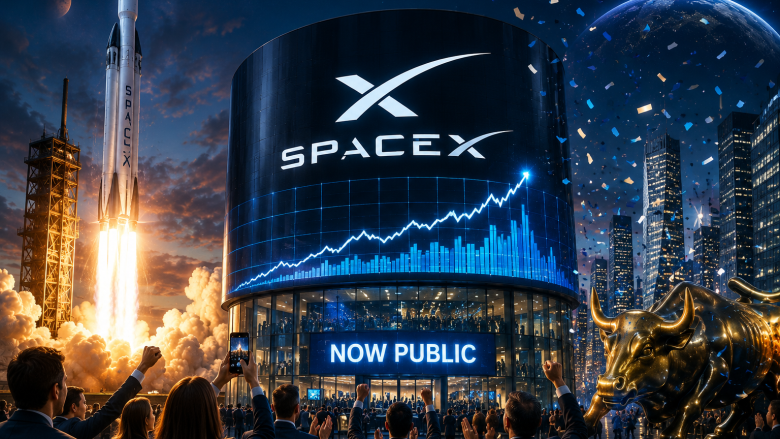
On June 12, 2026, a crowd gathered outside the Nasdaq MarketSite in New York and audibly cheered as Gwynne Shotwell rang the opening bell. SpaceX – the rocket company, satellite internet provider, artificial intelligence business, and social media platform all wrapped into one publicly traded entity – debuted under the ticker SPCX at $150 per share before closing its first day of trading at $160.95, a 19.2% gain from its $135 IPO price.
The numbers behind that debut are staggering. SpaceX raised $75 billion selling 555.55 million shares, making it the largest initial public offering in history – more than triple the size of Alibaba’s $21.8 billion US listing in 2014, which had held the record for over a decade. At its first-day close, SpaceX’s market capitalization exceeded $2 trillion, making it the fifth largest company in the world by market cap on its very first day as a public company.
For retail investors who have been watching SpaceX from the sidelines for two decades, the doors are now open. The question is whether it makes sense to walk through them – and at what price.
The Business Behind the Ticker
Understanding what you are buying when you purchase SPCX requires understanding that SpaceX is no longer simply a rocket company. The February 2026 merger with xAI – Elon Musk’s artificial intelligence startup behind the Grok large language model – created a combined entity spanning four distinct business segments, each at a different stage of financial maturity.
The Connectivity segment, driven primarily by Starlink satellite internet, is the financial engine of the company. For Q1 2026, Starlink generated revenue of $3.257 billion with operating income of $1.188 billion and adjusted EBITDA of $2.087 billion. Annualised, that is a $13 billion revenue run rate from a single product line with genuine global reach and a growing subscriber base that has proven its value in conflict zones, remote infrastructure, and maritime applications around the world.
The Space segment – rocket launches and manufacturing – generated Q1 2026 revenue of $619 million but posted an operating loss of $662 million, reflecting the enormous capital cost of Starship development. SpaceX disclosed in its S-1 that it has spent over $15 billion developing Starship, more than originally budgeted, and the programme’s twelfth test mission was scheduled for the week of the IPO itself. When Starship reaches full operational cadence, the economics of space launch will transform – but that timeline is still ahead, not behind.
The SpaceXAI segment – the xAI and Grok business – posted Q1 2026 revenue of $818 million alongside an operating loss of $2.469 billion, reflecting the massive compute investment required to compete in frontier AI. This is the segment with the longest path to profitability and the widest range of possible outcomes.
At the consolidated level, SpaceX reported Q1 2026 revenue of $4.694 billion and full-year 2025 revenue of $18.674 billion – a 33% year-over-year increase. The company posted a net loss of $4.94 billion in 2025, driven by xAI losses of approximately $2.5 billion per quarter. Adjusted EBITDA for 2025 was $6.584 billion – a metric that strips out the AI investment drag and shows the underlying cash generation of Starlink and the launch business.
The Retail Allocation That Made History
SpaceX CFO Bret Johnsen made the retail strategy explicit during the roadshow, telling bankers: “Retail is going to be a critical part of this and a bigger part than any IPO in history. Those are folks that have been incredibly supportive of us and of Elon for a long time, and we want to make sure that we recognize that.”
In a typical mega-cap IPO, retail investors receive 5–10% of share allocations. SpaceX set aside approximately 30% of the float – three times the standard – for individual investors. Access was distributed through Robinhood, Fidelity, and Charles Schwab, making it genuinely accessible to anyone with a brokerage account rather than exclusively to Goldman Sachs Private Wealth clients who typically receive priority in large offerings.
The demand reflected that access. According to Reuters and Bloomberg, SpaceX attracted more than $250 billion in total investor demand – roughly 3.5 times the $75 billion it was seeking to raise. Retail turnover in SPCX on its first day of trading reached $453 million, putting it on pace to surpass Coinbase’s first-day retail trading record from April 2021.
The Valuation Debate
At $160.95 at first-day close and trading in the $172–$188 range in the days that followed, the question every investor faces is whether the current valuation is justified.
At a market capitalisation of approximately $2.5 trillion at recent trading levels, SPCX is valued at roughly 135 times its 2025 adjusted EBITDA – a multiple that prices in an enormous amount of future growth from both Starlink’s continued subscriber expansion and the eventual profitability of the AI and space launch businesses. The average 12-month analyst price target stands at $188 per share, with a high estimate of $310 and a low of $62, according to Investing.com – a spread that reflects genuine disagreement about how to value a company with no clear comparable.
The bear case, articulated by sceptical analysts, rests on three pillars: the net loss position driven by AI investment ($4.94 billion in 2025), the concentration of voting control in Elon Musk’s hands (42% equity, 85% of votes), and the valuation premium required to justify $2.5 trillion for a company generating adjusted EBITDA of $6.5 billion. The high estimate assumes Starship transforms global space logistics, Starlink reaches hundreds of millions of subscribers, and xAI competes effectively with OpenAI and Google — a trifecta of outcomes, each of which is uncertain individually.
The bull case is equally coherent. Starlink has a multi-decade network effect advantage in satellite internet, with more than 7,000 satellites already in orbit and a manufacturing cost advantage that incumbents cannot replicate quickly. The Starship programme, once operational at scale, would reduce launch costs by an order of magnitude and unlock space-based data centres – an application SpaceX itself outlined in its S-1, noting plans to begin deploying orbital AI compute satellites as early as 2028. Goldman Sachs, which led the deal, did not put its credibility behind a transaction of this size without believing the growth trajectory was real.
What Retail Investors Should Think About
The SpaceX IPO is a once-in-a-generation investment event – the kind where the company’s name, its founder’s track record, and the sheer ambition of its business plan make it feel like a must-own stock. That feeling is worth examining carefully.
First-day IPO pops do not guarantee long-term returns. Coinbase, which surged on its April 2021 debut, subsequently fell more than 90% from its peak before recovering. Snap, Uber, and Lyft all posted strong first-day performances before extended periods of underperformance. The companies that have rewarded patient IPO investors – Amazon, Google, Salesforce – did so not because of their first-day price action but because their underlying business models compounded value consistently over many years.
Both CNBC’s IPO analysts and the Motley Fool’s research team made the same recommendation ahead of the SpaceX debut: treat any SPCX allocation as a high-risk, high-reward position within a diversified portfolio, not as a core holding. The concentration risk of a single name – even one with Starlink’s cash generation — does not warrant an oversized portfolio allocation, regardless of conviction in the long-term thesis.
The AI losses, running at $2.5 billion per quarter, are the most critical near-term variable to watch. If xAI does not show a credible path to revenue acceleration before SpaceX’s first public earnings report in November 2026, the market may reprice the AI segment’s contribution to the overall valuation. Investors should also monitor Starship’s test programme closely – successful full operational deployment would be a material positive catalyst; a significant test failure would be the opposite.
For investors who missed the IPO allocation, the stock is now available through any broker with Nasdaq access. At current prices, the risk-reward is more complex than at the $135 IPO price — but the underlying business is the same one that attracted $250 billion in demand during the roadshow.
The Bigger Picture
SpaceX’s public debut is more than a single investment decision. It is a signal about where capital markets believe the next decade of value creation will occur: at the intersection of space infrastructure, satellite connectivity, and artificial intelligence. The company’s S-1 is explicit about this vision – orbital AI compute satellites, Starlink as the connectivity layer for global AI inference, and Starship as the physical delivery mechanism for all of it.
Whether that vision materialises on the timeline SpaceX has outlined, at the cost structure its Starship programme promises, and with the competitive position against Microsoft Azure, Amazon Web Services, and Google Cloud that its orbital AI ambitions require – those are the questions that will determine whether SPCX is remembered as one of history’s great long-term investments or as an extraordinary debut that eventually demanded patience.
What is certain is that the largest IPO in history has arrived. The next chapter will be written in quarterly earnings reports, Starship test outcomes, and xAI revenue disclosures – beginning in November 2026.
Sources: SpaceX S-1 (SEC filing, May 20, 2026), CNBC, Yahoo Finance, Reuters, Bloomberg, BitMEX, Barchart, Investing.com, The Motley Fool, Stock Analysis, Stake, The VC Corner, TradingView