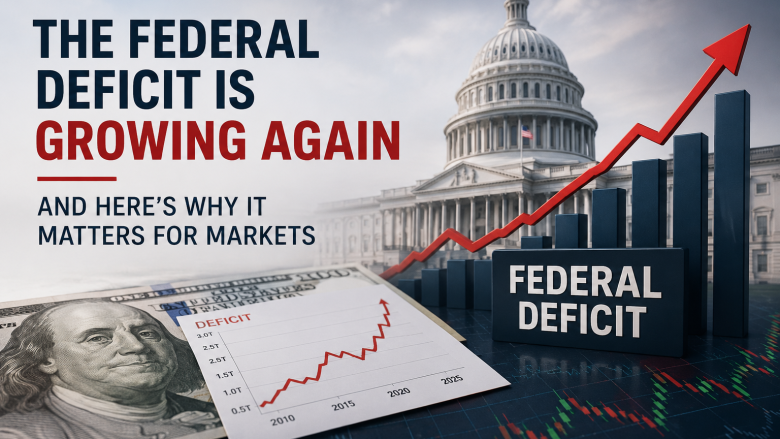
The United States federal deficit is back in the spotlight, and not in a way that reassures financial markets. The Congressional Budget Office’s May 2026 Budget and Economic Outlook projected a fiscal year 2026 deficit of $1.9 trillion — representing approximately 6.5% of GDP and surpassing the deficit levels of every year outside of the COVID-19 pandemic and the 2008 financial crisis. For a country not currently in a recession, this level of deficit spending is historically unusual and increasingly consequential for interest rates, inflation, and the broader financial system.
How the Deficit Got Here
The current deficit is the product of multiple compounding forces. Tax revenues have underperformed CBO projections for the second consecutive year, partly because capital gains realizations declined as equity markets corrected in Q4 2025, and partly because tariff revenues — while elevated — have not offset the economic drag they created. Meanwhile, mandatory spending continues its structural climb driven primarily by Social Security and Medicare, programs whose costs are locked in by demographic reality and existing law.
The Medicare trustees’ 2026 report projects that the hospital insurance trust fund will be depleted by 2031 — five years away — at which point benefits would face automatic cuts of approximately 11% unless Congress acts. Social Security’s trust funds are projected to be exhausted by 2033. These are not abstract long-term risks; they are near-term fiscal cliffs that will require legislative action, spending cuts, or tax increases — all of which carry their own economic consequences.
The third driver of the widening deficit is interest. Net interest payments on the federal debt are now running at an annualized rate of approximately $1.1 trillion, according to the Treasury Department’s Monthly Statement of the Public Debt. This is a staggering figure — it means that roughly 20 cents of every dollar the federal government spends goes to servicing existing debt rather than funding programs or services. As recently as 2019, that figure was 8 cents.
Debt-to-GDP and the International Context
The federal debt held by the public now stands at approximately $28.4 trillion, representing 97.8% of GDP. The IMF’s April 2026 Fiscal Monitor flagged the United States as one of a handful of advanced economies where the debt trajectory is “not on a sustainable path under current policies,” joining the United Kingdom and France in that uncomfortable category.
While the US benefits from the unique privilege of issuing the world’s reserve currency — a status that allows it to borrow at rates unavailable to other nations — that privilege is not unlimited. Fitch Ratings downgraded US sovereign debt from AAA to AA+ in August 2023, and S&P had done so even earlier in 2011. The persistence of large deficits at this stage of the economic cycle risks further credit pressure if the trajectory does not improve.
The Bond Market’s Verdict
The US Treasury bond market is the deepest and most liquid financial market in the world, and it is sending a clear signal. The 10-year Treasury yield, which stood at 3.6% in mid-2024, has climbed to approximately 4.7% as of June 2026. While multiple factors drive Treasury yields — including Federal Reserve policy expectations and global risk appetite — the persistent supply of new debt is unquestionably part of the equation.
The Treasury auctioned approximately $3.2 trillion in notes and bonds in fiscal year 2025, and the pace is expected to accelerate further in 2026. When supply outpaces demand, prices fall and yields rise. Rising yields feed back into the deficit itself — each 100 basis point increase in the average interest rate on outstanding federal debt adds roughly $280 billion to annual interest costs over a 10-year window.
Goldman Sachs’s rates strategy team published a note in May 2026 warning that “the combination of elevated deficit issuance and reduced foreign appetite for US Treasuries creates a structural upward bias for term premiums.” Foreign ownership of US Treasuries has declined from 33% of outstanding public debt in 2015 to approximately 24% today, as China has reduced its holdings and other major central banks have diversified reserves.
Fiscal Policy Options and Their Costs
The fiscal math is unforgiving. The CBO’s baseline projections show that even under relatively optimistic economic assumptions, the deficit remains above $1.5 trillion per year for every year in the 10-year forecast window. Bringing the deficit to a sustainable path — typically defined as stabilizing debt-to-GDP — would require either revenue increases, spending cuts, or economic growth materially above baseline projections.
The Brookings Institution calculated that stabilizing the debt-to-GDP ratio at its current level would require a combination of policy changes worth approximately 3.8% of GDP — roughly $1.1 trillion per year at current economic scale. There is currently no political consensus for measures of that magnitude, making fiscal consolidation in the near term unlikely.
Why This Matters for Investors and Households
For financial markets, a persistently high deficit matters through several channels. It keeps long-term interest rates elevated, which raises the cost of mortgages, car loans, and corporate borrowing. It crowds out private investment by absorbing a large share of available domestic savings. And it creates uncertainty about future tax policy, since the math ultimately has to add up — either through higher revenues, lower spending, or inflation that erodes the real value of outstanding debt.
For households, the most direct channel is the mortgage rate. The typical 30-year fixed mortgage rate tracks the 10-year Treasury closely, meaning that elevated Treasury yields translate directly into reduced affordability for homebuyers. At current rates, a $400,000 mortgage costs approximately $900 more per month than it would at 2020 interest rates — a difference that is pricing millions of potential buyers out of homeownership.
The deficit story does not have a near-term resolution. The political economy of fiscal consolidation is as unfavorable today as it has ever been, and the structural drivers of mandatory spending are demographic rather than discretionary. What investors and policymakers can do is understand the trajectory clearly — and begin pricing its consequences into their planning.
Sources: Congressional Budget Office, US Treasury Department, IMF Fiscal Monitor April 2026, Medicare Trustees Report 2026, Goldman Sachs, Brookings Institution, Federal Reserve, Fitch Ratings