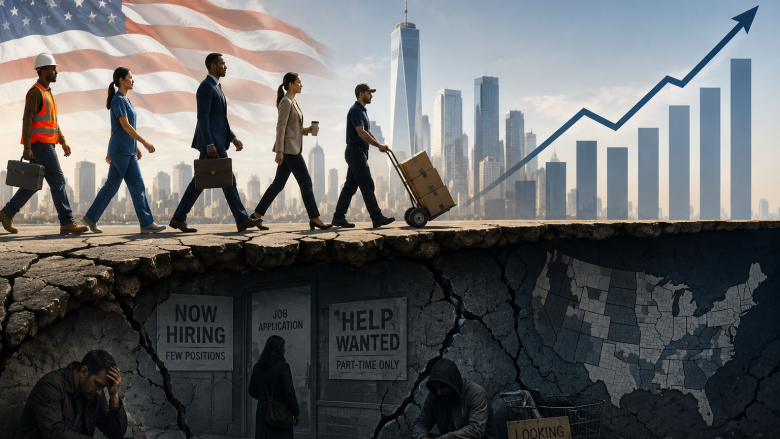
The headline unemployment rate in the United States tells a reassuring story. As of May 2026, the Bureau of Labor Statistics reported a jobless rate of 4.1%, still well within the range economists consider full employment. But dig beneath that figure, and a far more complicated picture emerges — one of structural mismatches, wage stagnation in key sectors, and growing anxiety among workers who technically have jobs but are struggling to make ends meet.
The Two-Speed Labor Market
The Federal Reserve’s May 2026 Beige Book described labor conditions as “cooling but not collapsing.” Job openings, which peaked at a historic 12 million in early 2022, have declined to roughly 7.2 million as of April 2026, according to the Job Openings and Labor Turnover Survey (JOLTS). That sounds like a significant slowdown, and it is — but the deceleration is not evenly distributed across industries.
Healthcare and social assistance added 52,000 jobs in April alone, continuing a hiring streak that has made it the most consistently growing sector in the economy. Government employment also remains robust, adding 23,000 positions. Meanwhile, manufacturing payrolls contracted for the fourth consecutive month, shedding 15,000 jobs in April, reflecting both import competition exacerbated by ongoing tariff uncertainty and the automation of assembly-line roles that once sustained middle-class households in Rust Belt communities.
Technology employment presents a paradox. While AI-related roles in software development, data engineering, and machine learning are growing rapidly — with LinkedIn reporting a 47% year-over-year increase in AI-adjacent job postings — traditional tech roles in customer support, content moderation, and back-office processing are being eliminated at scale. The net effect on payrolls appears muted, but the disruption to individual workers is severe.
Wage Growth: The Real Story
Nominal wage growth has decelerated from its 2022 peak of 5.6% annually to approximately 3.8% as of Q1 2026, according to the Atlanta Fed’s Wage Growth Tracker. On paper, this remains above the Federal Reserve’s 2% inflation target. But the problem is what inflation has done to purchasing power in the intervening years.
The Consumer Price Index shows that cumulative inflation since January 2021 has exceeded 22% in the United States. Even accounting for wage gains during that period, many lower- and middle-income workers find that their real purchasing power is meaningfully lower than it was five years ago. The Economic Policy Institute estimated in its March 2026 report that the bottom two wage quintiles have seen real wages decline by 3.2% since 2020 after adjusting for shelter, food, and energy costs.
The sectors with the strongest wage growth tend to be those that least need it — finance, technology, and professional services — while hospitality, retail, and healthcare support roles continue to lag. The Bureau of Labor Statistics data shows that leisure and hospitality workers earn a median hourly wage of $17.40, still 31% below the national median of $25.20.
The Participation Rate Problem
One of the most persistent challenges in the post-pandemic labor market is the labor force participation rate. At 62.7% in April 2026, it remains below the pre-pandemic rate of 63.4% recorded in February 2020. That gap of 0.7 percentage points sounds modest, but it translates to approximately 1.8 million workers who have exited the labor force entirely and are not counted in the headline unemployment figure.
The Federal Reserve Bank of San Francisco’s research suggests three primary drivers of this persistent participation shortfall: early retirement among baby boomers accelerated by pandemic wealth effects (now partially reversed), long COVID-related disability affecting an estimated 1.1 million workers according to the Census Bureau’s Household Pulse Survey, and a mismatch between available childcare and the wages on offer in lower-paid sectors.
The AI Displacement Question
Economists are increasingly grappling with whether AI is beginning to show up in labor market data in ways that were not visible a year ago. Goldman Sachs published research in April 2026 estimating that roughly 14% of all tasks in US office-based jobs are now being automated by AI tools to a meaningful degree. McKinsey’s Global Institute puts the share of work activities that could be fully automated with current AI at 29%.
The IMF’s World Economic Outlook from April 2026 echoed this concern, warning that advanced economies face “significant near-term dislocation” in white-collar employment as generative AI matures. The report noted that unlike previous waves of automation, which primarily affected routine manual tasks, AI automation is concentrated in cognitive, non-routine tasks — the work that education was supposed to make recession-proof.
What This Means for Policy and Your Finances
The Federal Reserve faces a genuinely difficult calibration problem. A labor market with 4.1% unemployment and 3.8% wage growth does not scream recession — but those headline figures obscure significant distress among specific cohorts of workers. The Fed’s dual mandate asks it to consider both price stability and maximum employment, and on the latter score, the quality of employment matters as much as the quantity.
For workers and households, the data suggests several practical realities. Job security in AI-exposed occupations is declining regardless of headline unemployment trends. Skills in data interpretation, complex judgment, and human-facing roles command the strongest wage premiums. And the traditional assumption that a college degree insulates workers from disruption is facing its first real test in a generation.
The labor market of 2026 is not broken. But it is deeply unequal in ways that standard measures are poorly equipped to capture — and that gap between the headline and the reality is itself a policy challenge that Washington has yet to seriously address.
Sources: Bureau of Labor Statistics, Federal Reserve Beige Book, Atlanta Fed Wage Growth Tracker, Economic Policy Institute, Goldman Sachs, McKinsey Global Institute, IMF World Economic Outlook April 2026, Federal Reserve Bank of San Francisco