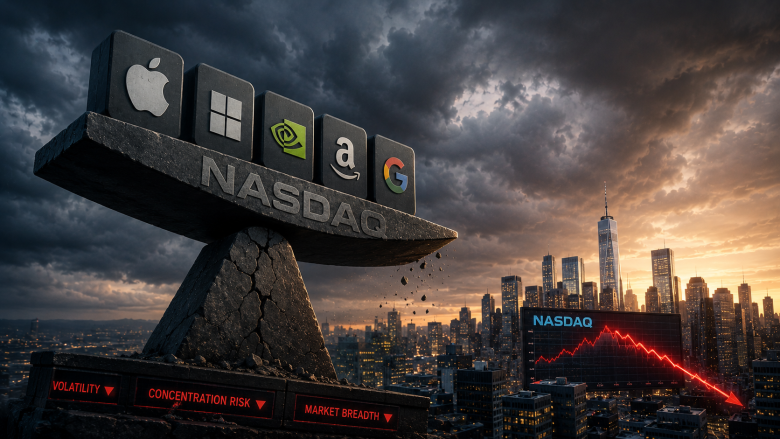
The Nasdaq Composite closed at record highs in May 2026, and the enthusiasm surrounding artificial intelligence continues to drive extraordinary valuations for a small group of technology companies. But underneath the index’s headline performance lies a structural concentration that has grown to historically unusual proportions — one that raises fundamental questions about index investing, diversification, and the risks embedded in passive strategies that most retail investors don’t fully appreciate.
The Concentration by the Numbers
As of May 2026, five companies — Nvidia, Microsoft, Apple, Alphabet, and Meta — account for approximately 42% of the Nasdaq-100’s total market capitalization. In the broader S&P 500, the top 10 holdings represent roughly 35% of the index, the highest concentration level since the peak of the dot-com bubble in 2000. For comparison, the average top-10 concentration in the S&P 500 over the past 40 years has been approximately 22%.
Nvidia’s rise has been particularly dramatic. The company’s market capitalization crossed $3.2 trillion in May 2026, making it briefly the most valuable company in the world by market cap — a position it has traded with Apple and Microsoft over the past year. Nvidia’s GPU chips are the essential infrastructure of AI model training and inference, and demand has outstripped supply so dramatically that the company’s revenue grew 265% year-over-year in fiscal year 2025. At current valuations, Nvidia trades at approximately 35 times forward earnings — historically elevated but far more rational than the 50-70x forward earnings it commanded during peak AI enthusiasm in mid-2024.
What Concentration Means for Index Investors
The vast majority of retail investors in the United States hold their equity exposure through passive index funds that track major benchmarks — a development that has been enormously positive for investor costs and long-term outcomes over the past two decades. But market-capitalization-weighted index investing has an inherent feature that becomes a meaningful risk at today’s concentration levels: the larger a company becomes, the more of it you own.
An investor holding a standard S&P 500 index fund allocates approximately 6.8% of their equity portfolio to Nvidia, 6.1% to Microsoft, 5.9% to Apple, and so on down the list. This is not a deliberate investment decision — it is the mechanical output of a methodology that weights holdings by market cap. And it means that the performance of a supposedly diversified index is increasingly driven by the business outcomes of a very small number of companies.
Research Affiliates, a quantitative investment management firm, published analysis in April 2026 showing that the equal-weighted version of the S&P 500 — where each of the 500 companies receives an identical 0.2% allocation — has underperformed the cap-weighted version by approximately 8 percentage points over the past two years, driven entirely by the outperformance of mega-cap tech. But that same analysis showed that historically, equal-weighted indexes outperform cap-weighted indexes over longer periods, because concentration eventually reverts as industries cycle and competitive dynamics shift.
The AI Valuation Question
At the core of the concentration debate is a fundamental disagreement about AI valuations. Bulls argue that the leading AI companies — Nvidia, Microsoft, Alphabet, Meta, and Amazon — are genuinely transforming their competitive positions in ways that justify elevated valuations. They point to revenue growth rates that have actually exceeded even optimistic forecasts, expanding AI-related revenue streams across cloud computing, advertising, and enterprise software, and the possibility that AI represents a technological step-change comparable to the internet — a comparison that ultimately proved correct even though internet valuations in 1999 were wildly excessive.
Bears point to the gap between the scale of AI infrastructure investment and the revenue currently being generated from AI-specific applications. Goldman Sachs’s technology research team estimated that the US technology sector spent approximately $600 billion on AI-related capital expenditure in 2025 — data centers, chips, energy infrastructure, and related equipment — while AI-specific revenue (excluding the general productivity gains embedded in existing products) totaled approximately $180 billion. That investment-to-revenue gap is not necessarily a sign of a bubble — the internet had a similar gap in the mid-1990s, and it ultimately proved well-justified — but it creates vulnerability if AI monetization takes longer than current valuations imply.
The Market Breadth Problem
A market in which a handful of stocks are driving the index while the majority of stocks underperform is technically described as having “narrow breadth,” and it is a pattern that historically precedes periods of market volatility. The S&P 500’s advance-decline line — which tracks the net number of stocks rising versus falling each day — has been diverging from the index’s price level for several months, a pattern that technical analysts identify as a warning signal.
Bespoke Investment Group’s analysis from May 2026 found that only 41% of S&P 500 components are currently trading above their 200-day moving averages, even though the index itself is at record highs. This means that the index’s record performance is being driven by a minority of stocks — predominantly in the AI and technology space — while the majority of equities are in established downtrends.
Historical Parallels and Their Limits
The temptation to draw parallels with the dot-com bubble of 1999-2000 is understandable and partially valid. The concentration of market gains in a small number of technology companies, the extraordinary valuations being paid for growth, and the breathless media coverage of transformative technology all rhyme with that era. But important differences exist.
The companies driving the current rally are generating real, substantial, and growing revenues. Nvidia earned approximately $88 billion in revenue in fiscal year 2025 — more than any dot-com company ever generated. Microsoft’s AI-enhanced cloud and productivity businesses are delivering measurable revenue growth that analysts can verify in quarterly earnings. The speculative excess, to the extent it exists, is more about the valuations placed on real businesses than about companies with no revenue or product.
What Prudent Investors Should Consider
The concentration in major equity indexes does not require investors to make binary bets on AI success or failure. What it does require is awareness that “buying the market” through an S&P 500 index fund is currently equivalent to making a meaningful bet on a small number of technology and AI companies — not on the broad US economy.
Investors who want genuine diversification may find value in complementing market-cap-weighted index exposure with equal-weighted alternatives, sector diversification across value and cyclical sectors, international equity exposure, and alternative assets with low correlation to mega-cap technology. The goal is not to bet against AI — it may well prove the most transformative technology of the century — but to ensure that portfolio outcomes are not entirely dependent on the success of any single narrative.
Sources: Nasdaq, S&P Global, Research Affiliates, Goldman Sachs, Bespoke Investment Group, Nvidia financial reports, Federal Reserve