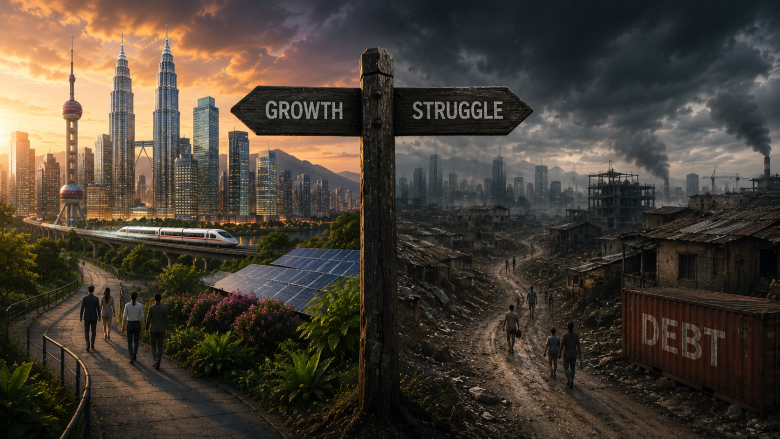
Emerging markets as an asset class have always resisted easy generalization. A Bloomberg index lumping together Brazil, India, South Korea, Saudi Arabia, and Nigeria as a single “emerging market” category obscures more than it reveals. But in 2026, the divergence within the emerging market universe is more pronounced than it has been in a generation, driven by fundamentally different exposures to oil prices, AI investment flows, dollar strength, and the ongoing restructuring of global supply chains. Understanding which countries are on the right side of these trends — and which are not — matters enormously for investors and policymakers alike.
India: The Standout Story
India is the most compelling large-economy growth story in the world in 2026. The IMF’s April World Economic Outlook projects Indian GDP growth of 6.8% for 2026, making it the fastest-growing major economy on the planet for the third consecutive year. The drivers are well-documented but worth restating: a young and growing population (median age 28), rapid infrastructure investment including the world’s most ambitious highway, rail, and renewable energy buildout, a services export sector anchored in technology that is benefiting from AI-driven demand for software development, and a manufacturing sector that is increasingly capturing supply chain investment redirected away from China.
India’s equity market has reflected this fundamental strength. The BSE Sensex has outperformed most major global indices over the past three years, and foreign institutional investor flows into Indian equities reached a record in 2025. The Indian rupee, while not immune to dollar strength, has been among the more stable emerging market currencies due to the Reserve Bank of India’s careful management and India’s relatively low external debt burden.
The risks to India’s trajectory are real: political considerations around market access and regulatory predictability, infrastructure bottlenecks that limit growth in manufacturing-intensive sectors, and a financial system that still has pockets of stress in state-owned banks. But the fundamental growth story remains intact and is, if anything, strengthening as geopolitical dynamics channel more investment toward India as a Chinese manufacturing alternative.
Brazil: Commodity Windfall and Structural Headwinds
Brazil is an instructive contrast. As a major exporter of oil, iron ore, soybeans, and agricultural commodities broadly, Brazil is a significant beneficiary of the commodity price surge of 2025-2026. Petrobras reported record profits in its most recent quarterly earnings, and Brazilian agricultural exporters have benefited from elevated global food commodity prices. The IMF projects Brazilian GDP growth of 2.9% for 2026 — solid by any measure.
But beneath the commodity dividend, Brazil faces structural challenges that limit its medium-term growth potential. Fiscal policy has been a persistent concern: the Lula administration’s spending increases combined with the high cost of servicing Brazil’s substantial public debt have pushed the primary deficit to levels that international investors find uncomfortable. The Brazilian real has depreciated approximately 8% against the dollar in 2026, partly reflecting fiscal concerns and partly the broader dollar strengthening driven by US rate differentials.
Brazil’s infrastructure deficit — despite recent investment — continues to limit the competitiveness of its non-commodity sectors. The World Bank’s Logistics Performance Index ranks Brazil 52nd globally, far below what would be expected for an economy of its size. Transportation costs for moving agricultural goods from the interior farm states to coastal ports remain among the highest in the world, eroding the competitiveness advantage that Brazil’s fertile soils and favorable climate provide.
The Oil Exporters: Windfall but Vulnerability
For Gulf Cooperation Council economies — Saudi Arabia, UAE, Qatar, Kuwait, Bahrain, and Oman — the oil price surge of 2025-2026 has been an enormous fiscal windfall. Saudi Arabia’s Vision 2030 diversification program is benefiting from the oil revenues that fund its ambitious investment projects, including NEOM and the giga-projects that are transforming the kingdom’s economic landscape.
But elevated oil prices are a double-edged sword for economic diversification. When oil revenues are abundant, the political pressure to advance difficult structural reforms — reducing public sector employment, developing non-oil private sector jobs, continuing the painful process of reducing energy subsidies — diminishes. The Dutch Disease risk is real: oil wealth strengthens the currency (or in the case of the Saudi dollar peg, sustains spending levels) in ways that undermine the competitiveness of non-oil sectors.
Moody’s 2026 Gulf sovereign credit assessment acknowledged the fiscal improvement from higher oil prices while flagging that “hydrocarbon dependency remains the fundamental credit constraint” for most GCC sovereigns, noting that breakeven oil prices — the price per barrel needed to balance the fiscal budget — have risen alongside spending as governments have expanded social programs and investment commitments.
Frontier Markets Under Pressure
While the larger emerging economies navigate commodity cycles and geopolitical tailwinds, many smaller frontier market economies face severe stress. The Institute of International Finance tracked 21 emerging and frontier market countries in some form of debt distress in early 2026 — a list that includes Pakistan, Sri Lanka (still recovering from its 2022 crisis), Ghana, Ethiopia, and several Central American nations.
The common thread in frontier market debt distress is the toxic combination of dollar-denominated external debt, a strong US dollar (which increases the local-currency cost of debt service), elevated commodity import costs (food and fuel prices hitting import-dependent economies particularly hard), and limited access to international capital markets at viable rates. IMF bailout programs have proliferated: the Fund has active programs in 21 countries and committed record resources to its resilience and sustainability trust.
The Capital Flow Dynamic
Capital flows are the lifeblood of emerging market financing, and the current environment is challenging for most of the universe. The Institute of International Finance’s Emerging Market Capital Flows Monitor reported net capital outflows from developing economies of approximately $87 billion in Q1 2026, as elevated US interest rates maintained the attractiveness of dollar-denominated assets relative to emerging market alternatives.
The exception is the handful of large emerging markets — India, Mexico, Indonesia, and the UAE — that have attracted significant foreign direct investment driven by supply chain reshoring dynamics. These FDI flows are more stable than portfolio flows and represent a genuine structural improvement in the capital account positions of recipient economies.
What Investors Should Watch
For investors considering emerging market exposure, the key differentiators in 2026 are: commodity export profile (oil and agricultural exporters are advantaged), position in global supply chain reconfiguration (friend-shoring beneficiaries like India and Mexico outperform), fiscal discipline (countries with credible fiscal frameworks can better manage dollar headwinds), and proximity to US rate cycle (the more the Fed cuts rates, the more capital flows back to higher-yielding EM assets).
The broadest lesson from emerging market divergence is that country selection matters more than asset class selection. An investor with undifferentiated EM exposure will average strong and weak performers in ways that deliver mediocre results. The opportunity — and the analytical challenge — is identifying the specific countries and sectors where fundamentals, policy quality, and geopolitical positioning align most favorably for the current environment.
Sources: IMF World Economic Outlook April 2026, Institute of International Finance, World Bank Logistics Performance Index, Moody’s Gulf Sovereign Credit Assessment, BSE Sensex data, Reserve Bank of India