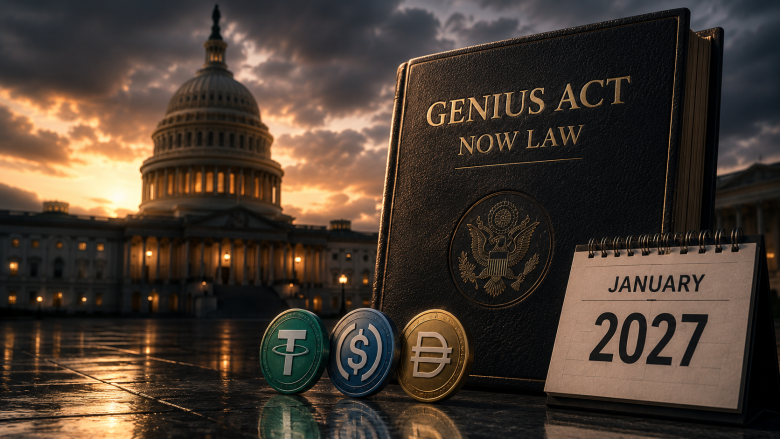
On July 18, 2025, the United States became the first major economy to enact comprehensive federal stablecoin legislation. The GENIUS Act — Guiding and Establishing National Innovation for U.S. Stablecoins — passed the Senate 68-30 and cleared the House 308-122 before being signed into law, governing a market that has since grown beyond $240 billion in total capitalization.
Nearly a year later, the compliance machinery is still being assembled. Federal regulators are racing to finalize implementation rules, issuers are making strategic pivots, and one critical question — whether the world’s largest stablecoin, Tether’s USDT, can legally operate in the United States after January 2027 — remains unresolved.
For market participants, the window between now and that January deadline is not a grace period. It is a compressed operating environment in which regulatory, competitive, and structural risks are being repriced simultaneously.
What the Law Actually Requires
The GENIUS Act establishes 1:1 reserve backing as the foundational requirement for all permitted payment stablecoin issuers operating in the United States. Issuers must hold reserves in short-term US Treasuries or cash equivalents and disclose the composition of those reserves on a monthly basis. The law also prohibits stablecoin issuers from paying yield directly on stablecoin balances — a provision designed to draw a clear regulatory line between payment instruments and investment products.
Only “permitted payment stablecoin issuers” — licensed depository institutions, OCC-approved nonbank entities, or state-regulated issuers meeting comparable standards — may legally offer stablecoins to US persons after the law’s three-year implementation window closes. Beginning July 18, 2026, federal and state regulators are required to have issued additional regulations specifying licensing requirements, capital standards, custody requirements, and AML/BSA compliance obligations.
The anti-money laundering dimension moved quickly. On April 10, 2026, FinCEN and OFAC published a joint proposed rule in the Federal Register treating stablecoin issuers as financial institutions for AML purposes — requiring full Bank Secrecy Act compliance programs, customer identification, suspicious activity reporting, and the operational ability to act on OFAC designations on-chain. The comment period for that rule closed on June 9, 2026.
Circle’s Structural Advantage
Circle’s USDC was already positioned to meet the GENIUS Act’s requirements. The company’s reserve structure — dominated by short-dated US Treasuries held in the Circle Reserve Fund — aligns directly with the 1:1 reserve mandate. Circle received OCC conditional approval for a national trust bank charter (First National Digital Currency Bank) in December 2025, giving it federally regulated custody infrastructure ahead of most competitors.
Its CPN Managed Payments product, launched April 8, 2026, brings USDC into banks and fintechs without those institutions needing to directly manage digital assets — a product architecture designed precisely for the post-GENIUS Act compliance environment. USDC holds approximately 27% of the global stablecoin market as of May 2026, according to CoinGecko data, a share that many analysts expect to grow as regulatory clarity advantages compliant issuers over offshore alternatives.
The Tether Problem
Tether’s USDT holds approximately 67% of the global stablecoin market — a dominant position built almost entirely outside the US regulatory perimeter. Tether operates primarily offshore, headquartered in the British Virgin Islands. The GENIUS Act’s jurisdiction is focused on US-domiciled issuers, which means Tether sits outside the law’s direct audit and compliance framework unless the US Treasury Department issues a determination that Tether’s jurisdiction has “comparable” regulatory standards.
As of May 2026, that determination has not been issued. The practical implication, as Senator Reed stated upon reintroducing S.3907 — the Foreign Stablecoin Transparency Act — is stark: “USDT can be freely offered, sold, and used by Americans even though the GENIUS Act does not require Tether to provide a full accounting of the reserves backing its stablecoin.”
S.3907 would directly close this gap, requiring foreign-issued stablecoins with material US market presence to submit to full reserve audits as a condition of continued exchange access. If passed and if Tether refuses compliance, US-regulated exchanges would face pressure to restrict USDT — an outcome with immediate systemic consequences given that USDT remains the dominant collateral asset on major derivatives venues globally.
Tether has disclosed holdings of approximately $100 billion in US Treasury securities, over 82,000 Bitcoin, and 48 metric tons of gold. Despite these disclosures, it has not yet completed a full independent audit by a Big Four accounting firm, though CEO Paolo Ardoino announced in March 2025 that the company was working to engage one.
A Two-Tier Market in the Making
The GENIUS Act has accomplished something important but incomplete: it has established a clear compliance pathway for US-domiciled stablecoin issuers while leaving the market’s dominant player in a regulatory no-man’s land. This asymmetry is creating a two-tier stablecoin market with implications that reach well beyond the crypto industry.
On one side, fully compliant issuers like Circle operate under increasing federal oversight with clear rules for reserves, custody, and AML compliance. On the other, Tether continues to serve the majority of the market — including its role as the primary collateral underpinning global crypto derivatives markets — without equivalent transparency obligations.
The stakes of this divergence are considerable. A forced delisting of USDT from US exchanges would not simply inconvenience retail holders. It would create dislocations in perpetual futures funding rates on major offshore venues like Bybit and OKX, require rapid rotations of collateral portfolios, and potentially destabilize liquidity across the broader crypto ecosystem. The systemic footprint of USDT is large enough that even a partial delisting would register as a macro event across digital asset markets — a tail risk that most portfolio risk models have not yet priced.
For compliant issuers, however, the GENIUS Act represents a structural moat. The compliance costs — full AML programs, monthly reserve disclosures, custody infrastructure, OCC licensing — are substantial and create high barriers to entry for new competitors. Institutions like banks, which can now issue stablecoins through FDIC-approved subsidiaries under the law, will likely take 12–18 months after the final rules are issued before their first products appear. Circle and the existing licensed issuers have a meaningful head start in the race for institutional adoption.
What Investors Should Watch
Four regulatory and legislative milestones will define the stablecoin landscape through the January 2027 deadline.
The July 18, 2026 regulatory deadline is the first and most immediate. The OCC, FDIC, and FinCEN are required to finalize implementation rules by that date. These rules will establish the operational compliance framework that issuers must meet and clarify exactly which entities qualify as permitted payment stablecoin issuers. Delays or ambiguities in this rulemaking will extend uncertainty for all market participants.
The Treasury’s equivalency determination on Tether is the single most market-relevant decision in the stablecoin space. A positive determination gives USDT a clear operating path in the US market. A negative determination — or no determination — leaves USDT in continued regulatory limbo and makes S.3907 more likely to advance through Congress.
S.3907’s legislative progress deserves close monitoring for any investor with significant USDT exposure. A committee vote or meaningful floor support for the Foreign Stablecoin Transparency Act would be an early warning signal that Tether’s US market access is under genuine legislative threat — a scenario that would require urgent portfolio repositioning for anyone relying on USDT as a trading or collateral instrument.
Finally, the timeline for bank-issued stablecoins will signal how quickly traditional financial institutions intend to compete in the space. The first bank-issued stablecoins are expected by late 2026 or early 2027. When they arrive, they will compete directly with Circle and Tether for institutional adoption. Banks carry inherent credibility advantages with traditional financial counterparties — a factor that could accelerate USDC displacement in enterprise use cases even faster than current market share trends suggest.
The Six Months That Will Define Stablecoin Regulation
The GENIUS Act marks a turning point — the moment when stablecoin regulation moved from regulatory arbitrage and enforcement-by-prosecution to a structured federal framework with clear rules, clear timelines, and clear consequences for non-compliance. For Circle and other US-domiciled issuers, the law is a competitive shield as much as a compliance burden. For Tether, it is an existential inflection point that the market has not yet fully priced.
The next six months — the window between the July 2026 regulatory deadline and the January 2027 full compliance date — will determine whether the world’s largest stablecoin finds a path to regulatory legitimacy in its most important market, or whether US investors are forced to choose between a compliant stablecoin ecosystem and the liquidity infrastructure they currently depend on.
That is not a niche regulatory question. It is a structural market question with consequences for every investor who holds stablecoins, trades crypto derivatives, or simply uses USDT as a dollar-denominated settlement layer in a global portfolio. The answer will be written in the Federal Register, the halls of Congress, and Tether’s own auditor engagement — and the timeline for all three is shorter than most market participants have appreciated.
Sources: Phemex, TRM Labs, AOTrading, VaasBlock, Spaziocrypto, Georgetown Journal of International Law, FinTech Weekly, Congress.gov, BDO, CoinGecko, FinCEN, OFAC Federal Register