Consumer debt in the United States has reached a record $17.7 trillion as of Q1 2026, according to the Federal Reserve’s Household Debt and Credit Report. Credit card balances alone stand at $1.19 trillion — the highest level in history — with the average credit card interest rate at 21.6%, meaning that Americans are paying more to carry debt than at any point in modern financial history. For the tens of millions of Americans managing significant high-interest debt, the question of how to pay it down effectively is not academic — it is one of the most financially consequential decisions they will make.
The True Cost of High-Interest Debt
The mathematics of high-interest debt are sobering and often insufficiently understood. A credit card balance of $5,000 at 21.6% annual percentage rate, on which the cardholder makes minimum payments of approximately 2% of the balance, will take approximately 30 years to pay off and will cost over $11,000 in interest — more than double the original balance. A $10,000 balance under the same conditions would cost over $22,000 in interest and take approximately 35 years to eliminate.
These numbers reflect the brutal mathematics of compound interest working against the borrower rather than for them. The same compound growth that makes disciplined investing so powerful becomes a devastating force when it operates on debt — and at 21.6%, it operates very quickly. A dollar of credit card debt at 21.6% becomes $1.216 in one year, $1.48 in two years, and $2.40 in five years. Eliminating high-interest debt is the equivalent of earning a guaranteed, after-tax return equal to the interest rate — a return that no investment can reliably match, particularly after accounting for taxes on investment gains.
The Avalanche Method: Mathematically Optimal
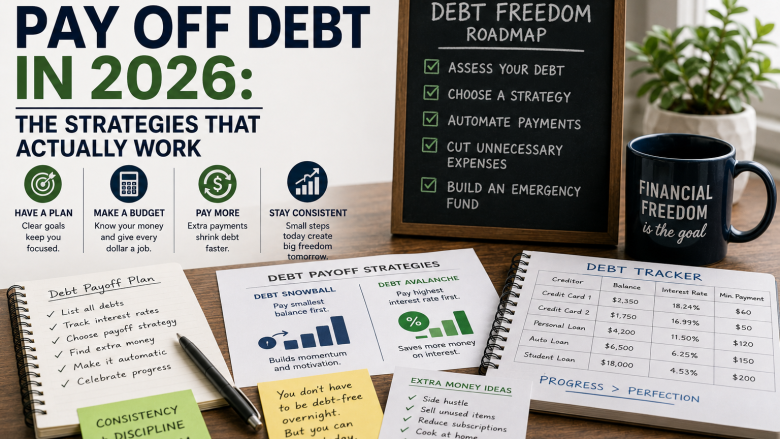
The debt avalanche — paying minimum payments on all debts and directing every additional dollar toward the highest-interest-rate debt first — is the mathematically optimal debt repayment strategy. By eliminating the highest-interest debt first, the borrower minimizes total interest paid and eliminates debt in the shortest possible time, all else being equal.
A household with three debts — a credit card at 24% ($3,000 balance), a personal loan at 15% ($7,000 balance), and a car loan at 7% ($12,000 balance) — would under the avalanche method direct every extra dollar toward the credit card first, then the personal loan, then the car loan. This approach saves the maximum amount in total interest over the repayment period.
The practical challenge of the avalanche method is behavioral: if the highest-interest debt is also the largest, it can feel like progress is happening slowly, creating temptation to abandon the strategy before it delivers results. Research in behavioral economics by Franklyn Gallo at the Harvard Business School found that approximately 28% of people who start the avalanche method abandon it within six months, citing discouragement at the slow visible progress on the target balance.
The Snowball Method: Psychologically Powerful
The debt snowball — paying minimum payments on all debts and directing every extra dollar toward the lowest-balance debt first — was popularized by financial personality Dave Ramsey and has become the most widely recommended debt repayment strategy in personal finance media. It is not the mathematically optimal strategy, but it leverages behavioral psychology in ways that make it more likely to be completed.
By eliminating small balances first, the snowball method creates frequent “wins” — the satisfaction of paying off a debt entirely and eliminating the associated minimum payment — that maintain motivation and momentum. Research by Keri Kettle at the University of Toronto and colleagues, published in the Journal of Marketing Research, found that debt holders who focused on paying off individual accounts sequentially (snowball) were significantly more likely to eliminate all their debt than those who optimized across accounts (avalanche).
The cost of the snowball method relative to the avalanche is typically a few hundred to a few thousand dollars in additional interest paid — a real cost, but potentially worth it if the alternative is abandoning the debt repayment effort entirely. For most households, the optimal strategy is the one they will actually follow through on, which makes the behavioral advantage of the snowball a legitimate consideration.
Balance Transfer Cards: A Powerful Tool Used Carefully
Balance transfer credit cards offer promotional interest rates — often 0% for 12-21 months — on balances transferred from other credit cards. For borrowers with good credit (typically a FICO score above 700) who have the discipline to pay off or significantly reduce the balance during the promotional period, balance transfers can save hundreds or thousands of dollars in interest while accelerating debt elimination.
The critical caveats: balance transfer fees are typically 3-5% of the transferred amount, meaning that transferring $10,000 costs $300-$500 upfront. The interest rate after the promotional period typically reverts to a high rate — often 25-29% — so any remaining balance becomes expensive immediately. And opening a new credit card creates a hard inquiry on credit reports that temporarily reduces credit scores, though this effect is small and temporary.
The Consumer Financial Protection Bureau’s 2025 consumer credit report found that balance transfers are most effective for consumers who transfer no more than they can realistically pay off during the promotional period and who do not use the original credit card to accumulate new debt while the transferred balance is being paid. These sound like obvious rules, but the CFPB’s research found that a meaningful minority of balance transfer users accumulate new debt on the original card, ending the process with higher total balances than they started with.
Debt Consolidation Loans: A Different Approach
Personal loans for debt consolidation — offered by banks, credit unions, and online lenders — allow borrowers to combine multiple high-interest debts into a single loan at a lower interest rate and fixed monthly payment. The current market for personal loans shows rates ranging from approximately 9-12% for borrowers with excellent credit to 18-25% for borrowers with lower scores.
For a borrower carrying multiple credit card balances at 20-24% who can qualify for a consolidation loan at 12%, the interest savings over a 3-5 year repayment period are substantial. The fixed payment schedule also provides clarity and discipline that revolving credit card debt does not — there is a defined payoff date rather than a potentially endless minimum payment cycle.
Credit unions are often the best source of debt consolidation loans for members, offering rates that typically run 1-3 percentage points below what banks charge for comparable borrowers. The National Credit Union Administration’s data shows that credit union personal loan rates averaged 10.6% in Q1 2026, compared to 12.8% for comparable bank products.
Negotiating With Creditors: More Possible Than Most People Know
Many Americans are unaware that credit card companies will frequently negotiate interest rates, payment plans, and even debt settlement with borrowers who contact them directly. This is particularly true for borrowers experiencing genuine financial hardship — the card issuer’s alternative, if the borrower defaults and they must sell the debt to a collections agency, typically returns only 5-10 cents on the dollar. An offer of 50-70 cents on the dollar as a lump-sum settlement is therefore economically attractive to the issuer, even if it represents a significant loss from the borrower’s perspective.
For borrowers facing temporary financial stress but not wanting to default, a hardship program — where the issuer temporarily reduces the interest rate to 0-6% and may waive fees — is available at most major card issuers. These programs are typically offered for 12-18 months, do not require closing the account, and are not reported to credit bureaus as negative information. The CFPB encourages borrowers experiencing hardship to contact their lenders before missing payments, as the options available before default are far more favorable than those available afterward.
The Order of Operations for Debt Payoff
For households managing both debt and saving decisions simultaneously, the order of financial priorities that the data and financial planning research most clearly supports is: first, establish a minimal emergency fund (1 month of expenses) to avoid new debt from unexpected costs; second, capture any available employer 401(k) match (this is guaranteed return that exceeds any debt interest rate); third, eliminate high-interest debt (above approximately 7%) as aggressively as possible; fourth, rebuild the emergency fund to 3-6 months of expenses; fifth, contribute further to retirement accounts and other investment goals.
The specific threshold at which debt payoff takes priority over investment varies by individual risk tolerance and the opportunity cost calculation — in an era of 4-5% Treasury yields, the case for paying off 5-6% debt before investing is weaker than when investment returns are lower. But for high-interest consumer debt above 10-12%, the math almost always favors aggressive payoff before any discretionary investing above the employer match level.
Sources: Federal Reserve Household Debt and Credit Report Q1 2026, Consumer Financial Protection Bureau, National Credit Union Administration, Journal of Marketing Research, Harvard Business School behavioral economics research, Federal Reserve consumer credit data